
Project 2
Vignette Anthology
Year 2
Arnold. is a companion film: five short fairy-tale vignettes that transform lived experience into archetype and metaphor.
Proof of Concept
This 34-second scene demonstrates the core workflow I'll use to create Arnold.
The short film above is a stylized recreation of the 1980s Oakland assault that left my father permanently disabled—the event that transformed our family into a caregiving household for the rest of my childhood.
Although I used AI to generate the shots, I directed this film the way any filmmaker directs a shoot: composing shots with my sculpture, Cuckoo, as the performer, running takes until the footage matched my vision, rejecting what didn't work, then cutting and shaping the sequence into a story with meaning. The sculpture is mine. The compositions are mine. The editorial choices are mine. The AI rendered what I directed.
This is a proof-of-concept for what Arnold. will do five times, each in a different handmade world.

Cuckoo (face 1), handmade paper & steel, 2006

Cuckoo (face 1), stop-motion puppet
The True Story
Amelia. rough cut | part 2
Watch this segment to understand what our family lived through—and why I'm making Arnold. to tell it.

Why This Can't Be Told Literally
The proof-of-concept above shows what literal storytelling looks like: a man walking toward violence in the dark. Now imagine five entire vignettes like that, unmediated, without relief. That's not a film anyone can sit through—including me.

Arnold. transforms these experiences into fairy tales—not by softening what happened, but by reshaping it. Real suffering rarely resolves cleanly. Our story didn't come with an underdog victory or a neat lesson. But art can build what life refused: acts of courage, protectors who arrive in time, an ending where someone is finally understood, finally protected, or finally allowed to rest.
Arnold. is a companion film to Amelia.: five vignettes that turn lived experience into archetype and metaphor, offering a shared language for what many families carry quietly.
Cuckoo (face 2), handmade paper & steel, 2006
Five Vignettes
Each story is based on a real experience from my childhood, transformed into a small handmade world with its own materials, characters, and visual logic—using the same sculpture-to-animation workflow demonstrated above.
Each vignette becomes its own material world. Paper, crochet, and metal are not just aesthetics—they are emotional instruments. A soft world can hold tenderness. A hard world can finally admit what felt unbearable. Shifting styles mirrors how memory works over time: from confusion to dread to the moment you realize you have been surviving for a long time.
A father arrives at an elementary school like a wandering magician, carrying a bag of surprise gifts. Kids swarm him, delighted, while one child watches in panic because the “magician” is his dad, and something is off. Authority steps in and the spell breaks.
Repair move: the child stops covering with a lie and instead tells a small truth in a safe way, reclaiming dignity without betraying his father.
Material world: Crochet + felt + soft yarn props
Why: it reads as childhood, warmth, play, and safety. Even when the scene turns awkward, the softness keeps it from feeling cruel. The “mob of kids” can be charming instead of scary.
Two cheerful visitors come to the door to offer certainty and salvation. The father welcomes them into a conversation that spirals, and they keep trying to hold the thread, refusing to turn away. Later, the father calls an operator just to keep a human voice on the line.
Repair move: the “strangers” become witnesses rather than judges, and the child realizes that being seen does not automatically mean being shamed.
Material world: Paper collage + cardboard diorama + cut-out mouths
Why: paper is perfect for social performance. It can feel “polite” and brittle at the same time. The forced conversation can be shown literally as paper speech ribbons that tangle, tear, and get re-taped.
A mother and child return home after a long day and discover the father is gone. The house feels wrong, like a castle with an open gate. Panic builds because he is disabled and the outside world is dangerous. Neighbors search, police are called, and time stretches. Then a hired helper arrives, pushing him back home like a lost ruler returned to the throne.
Repair move: instead of blame, the ending reframes as community survival: help exists, people can return, the world can hold you.
Material world: Shadow-box miniatures + tissue “fog” + light through blinds. Why: suspense reads best in silhouette. A shadow-box house lets you show rooms, absence, and searching. The return can be a shift from hard shadows into warm lamplight.
A crowded holiday house in Vallejo is full of relatives and warmth, but an invisible storm lives in the same rooms. The father is unwell and smells of an accident, and the child feels exposed in front of everyone. Adults try to pretend nothing is happening, while the mother strains at the breaking point.
Repair move: a quiet relative steps out of denial and helps the mother without spectacle, shifting the burden from private shame to shared care.
Material world: Wax/clay figures in a crowded dollhouse set
Why: wax/clay can look slightly “sweaty,” fragile, and human. Faces can sag, smear, or crack. The crowded house can feel claustrophobic. Then the repair moment is literally hands helping reshape what’s collapsing.
After the father dies, the child meets him in a dream where he still believes he is trapped in his suffering body. The child slowly convinces him he is not bound anymore. The father begins to change, gaining freedom and power, and finally apologizes. The child takes him to an airport, a threshold between worlds, and helps him board toward light.
Repair move: forgiveness is not erasing the past. It’s releasing the living from carrying the pain forever.
Material world: Metal + wire armatures + translucent fabric and LEDs
Why: metal gives you the “old cage” feeling, constraint, wheelchair-body weight. Then the release is visual: wire becomes wings, translucent fabric becomes spirit, light turns the harsh structure into something radiant. It’s the biggest transformation payoff.
How I'll Make It
1 / Write + Storyboard
Short, tightly scoped scripts with clear beats and visual motifs. Designed to be finishable. The vignette form is the discipline: bounded scope, deliberate choices, no sprawl.
2 / Build Miniature Worlds
Hand-built sets, props, and sculptural characters that create a tactile cinematic look and a controlled shooting environment. Each vignette uses distinct materials matched to emotional tone.
3 / Finish + Screen in Vallejo
Edit, sound, and finalize the anthology for public presentation. Bring it back to Vallejo through a screening and a structured community conversation about story, memory, and meaning.
Why Make Anything by Hand?
Three reasons: authenticity, control and consistency.
Authenticity. Handmade work comes from a real person and a real process. I build objects from lived experience with my own hands, which means the work contains risk, accidents, imperfection, and discovery. I do not fully know the result at the start, and that uncertainty is part of the meaning.
The steel dog head Anubis was not "designed" and then executed. It was discovered through making. I cut, bent, welded, and forged steel while the piece was still becoming itself, responding to what the material could do and what the form demanded as it emerged. The most important moments happened late, when I had to solve the work by balancing it, editing it, and committing to a final shape. That kind of surprise only exists inside a real process.
Control. When I build a character or set by hand, every detail is a deliberate choice. The weight of a material, the texture of a surface, the exact angle of a gesture—these are decisions I make in response to what the story needs emotionally. AI can approximate a look, but it can't make the micro-decisions that give a character presence or a space meaning.
Consistency. Characters and details drift in AI outputs from shot to shot. Physical objects do not. Once I build a real puppet or sculptural character, I can photograph it from multiple angles and use those images to lock in consistency across the animation workflow. Real objects create a stable foundation that AI can enhance.
What AI actually does well
Once I have stable, handmade elements, AI becomes genuinely useful: adding subtle motion to a photographed puppet, extending a miniature set beyond its physical edges, creating atmospheric effects that would be cost-prohibitive to build practically. The tool works best when it's enhancing something real, not inventing from scratch.
Starting from real, built objects also solves one of the biggest problems in AI video: uncanny humans. When the audience knows they're watching a puppet or a crafted figure, they accept the material language immediately—the seams, the texture, the imperfect surfaces—because that's the grammar of stop-motion.
Click to enlarge.
Click to enlarge.

Anubis, steel, 2006

Stitch Head, paper mache, 2024

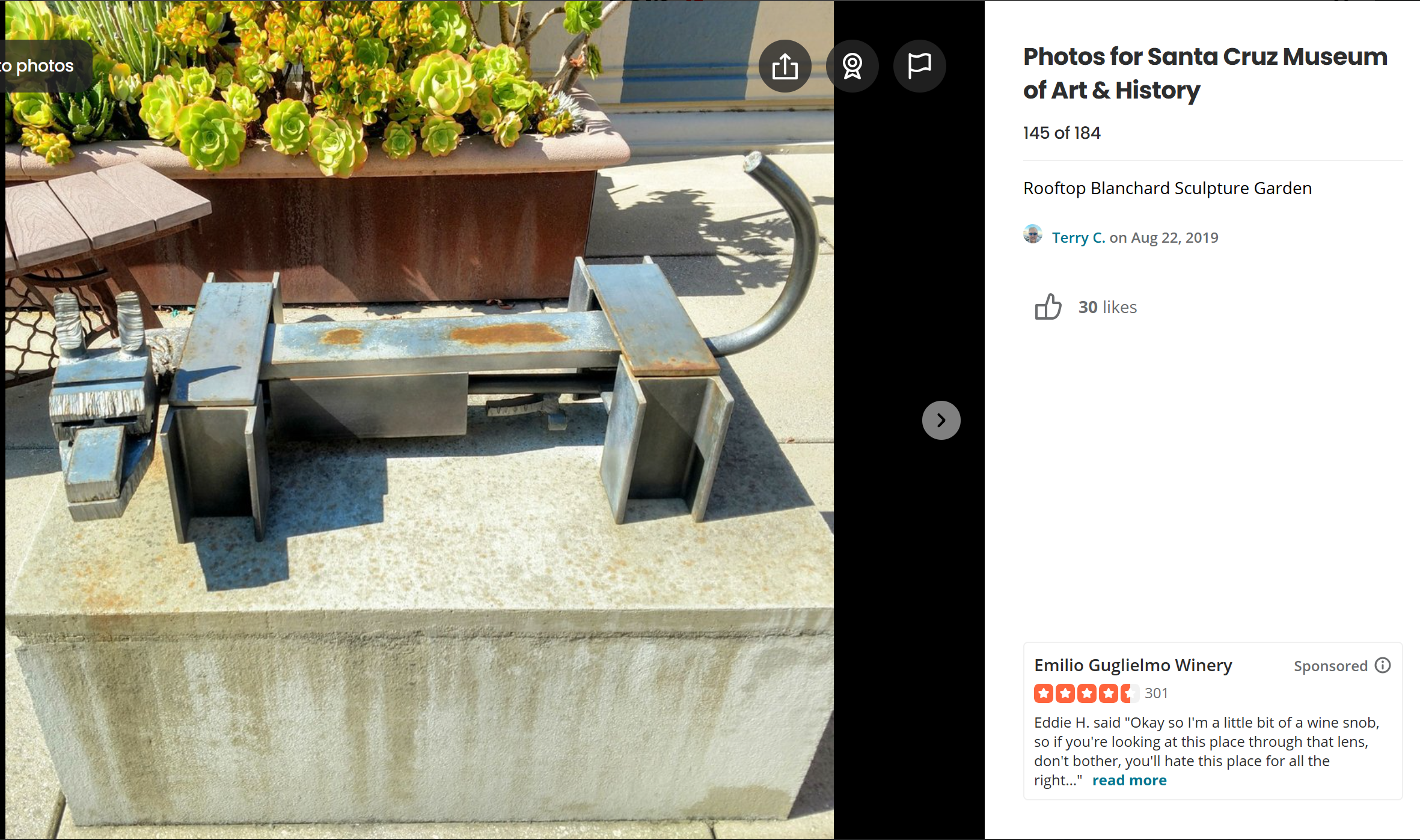
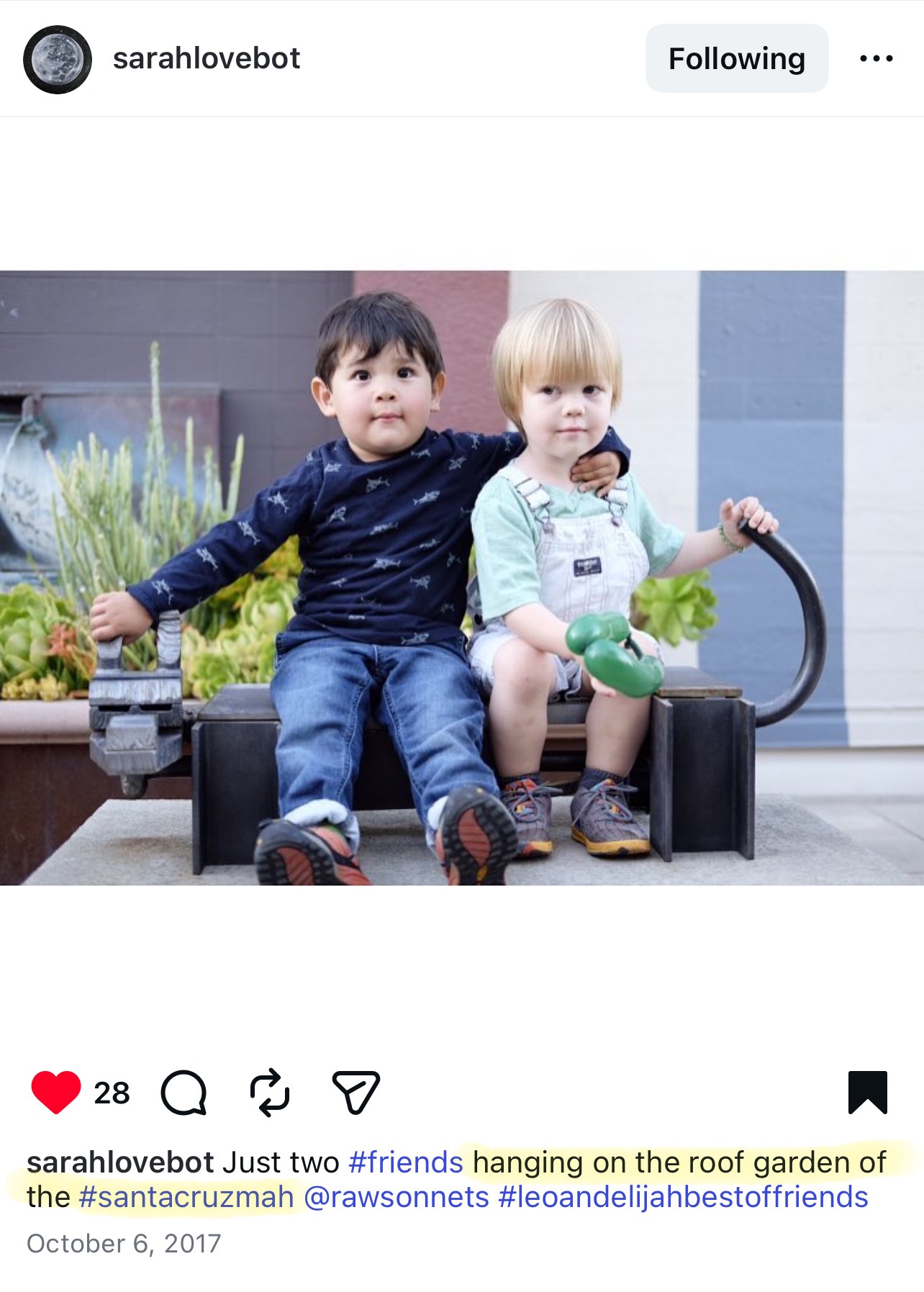
Corgi Four, steel, 2005
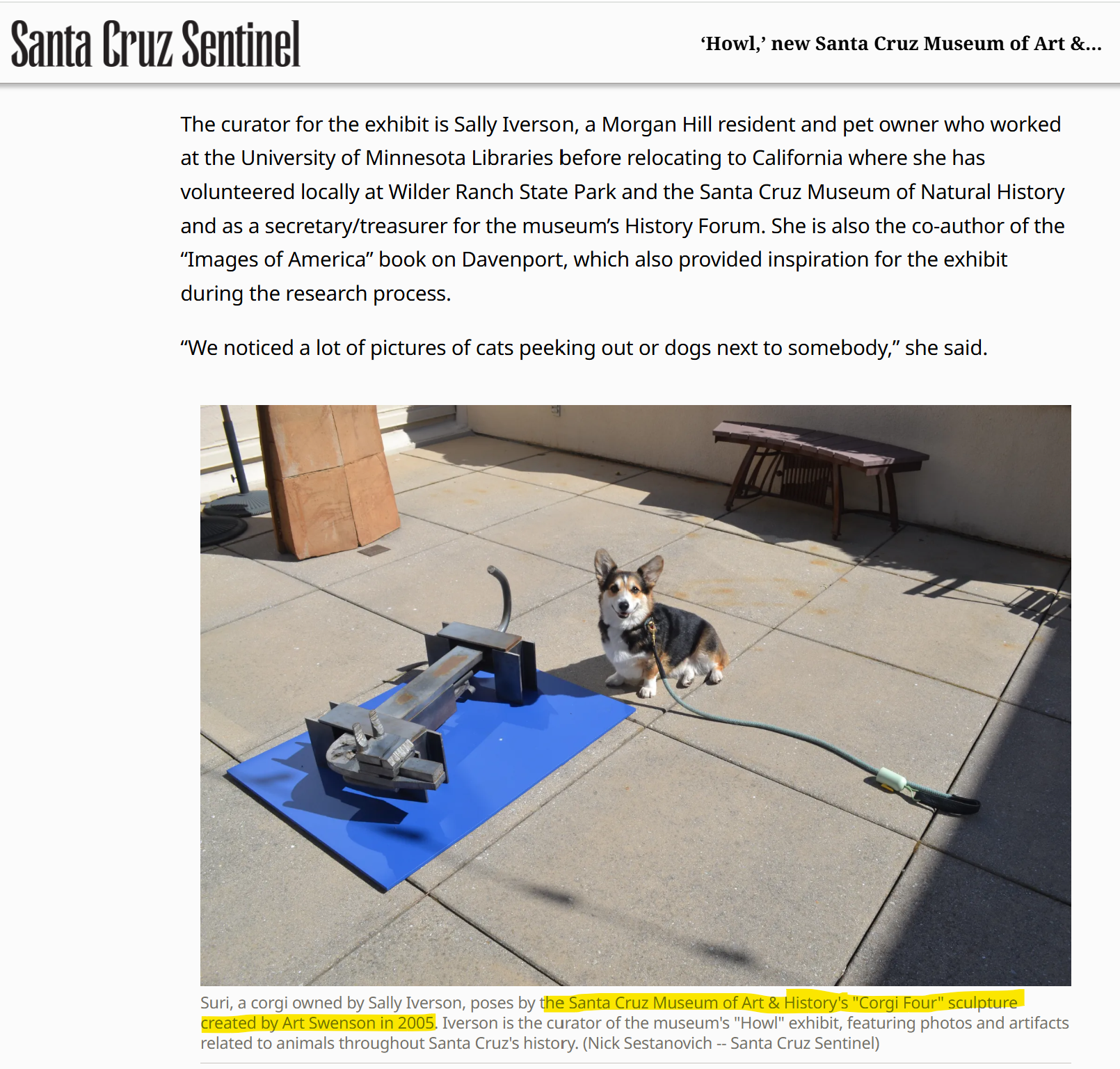
Corgi Four is part of rooftop sculpture garden, visit link:
Santa Cruz Museum of Art and History's permanent collection (requires subscription to open article. Click to enlarge.
What You'll Get
Primary deliverables:
-
Finished anthology film (five vignettes assembled as one cohesive work)
-
Trailer or excerpt reel
-
Captioned version (minimum English)
-
Screening-ready and web-ready exports
If scope allows:
-
Short behind-the-scenes process segment
-
Simple visual "making-of" page to deepen community engagement
Timeline:
-
Phase 1: Scripts, storyboards, and visual tests
-
Phase 2: Build sets, props, and characters; finalize shooting plan
-
Phase 3: Production (shooting plates and performances)
-
Phase 4: Edit, sound, finishing, captions, exports
Vallejo Screening & Community Discussion

The project ends where it belongs: back in Vallejo, shared with the community that shaped it.
Public Screening Arnold. will be presented at a Vallejo venue with outreach to local networks—family, faith community, Filipino cultural organizations, and caregiving advocates.
Empress Theater, Vallejo CA
Structured Community Discussion
Following the screening, a guided conversation using prepared prompts will invite collective reflection on the themes the vignettes carry:
-
Mental illness and disability — what families witness and endure
-
Caregiving — the invisible labor, the exhaustion, the love
-
Filipino cultural values — hiya (shame and social duty) and utang na loob (debt of gratitude) as forces that sustain and silence
-
Immigration — navigating cultural expectations far from home
-
Trauma and repair — how families process suffering across generations
This is not therapy or clinical services. It is cultural conversation—a space where people can interpret the stories, share their own recognition, and find language for what many families carry quietly.
The goal is to create work with and share it back to Vallejo, not just make art that happens to be set here.
The Love Underneath
This short documentary shows my pacing and emotional tone in a simple, everyday story.
Shot on an iPhone during a Ross trip. Edited into a story about teaching good choices as my daughter reunites Moana's family of toys. It features my mom—alive, present.
After everything heavy above, I wanted to end with what we actually had: small moments, family banter, and love.